Synthetic Artificial Grass is not a single material but a layered surface designed to imitate living turf. Its visible blades are commonly made from polyethylene, polypropylene, or nylon. Polyethylene is often selected for its softer feel. Manufacturers melt polymer pellets, form thin strands, and shape or texturize them to resemble grass blades. Color, thickness, height, and blade shape vary between products. Underfoot, those differences are easy to notice.
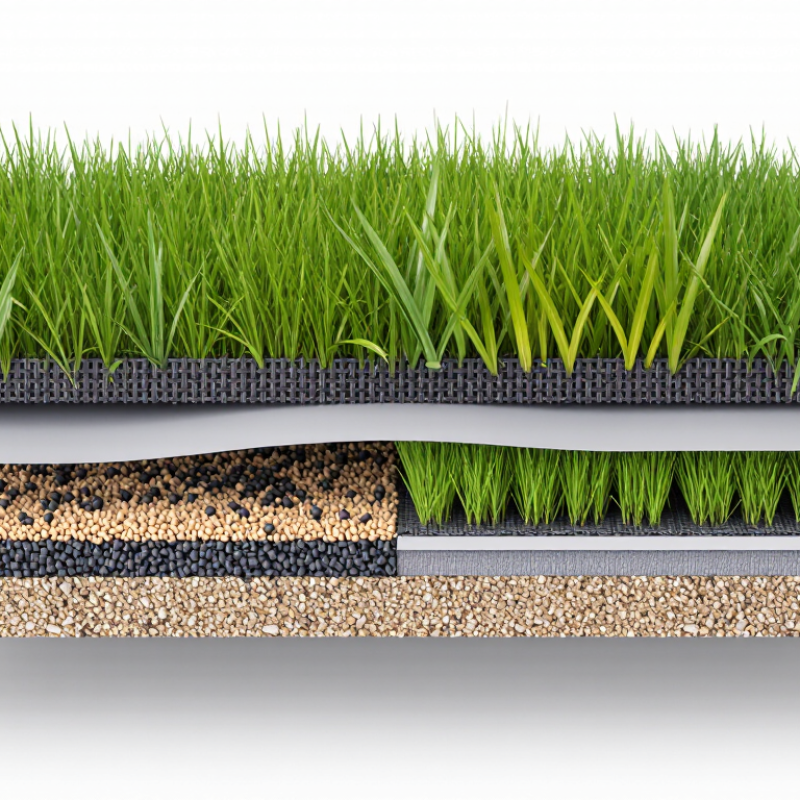
The fibers are usually tufted into a backing, often woven polypropylene. A coating, such as latex or polyurethane, helps hold the tufts in place. Some lawns also include infill, such as silica sand, coated sand, or rubber-based materials; other systems use little or none. The details matter. Infill can support the blades, affect drainage, and change how the surface feels. Drainage also depends on the backing and the prepared base beneath it. Product specifications are more useful than broad labels, since construction varies by manufacturer. A neat ingredient list cannot promise a cool, durable lawn. Heat, wear, and maintenance depend on the materials, installation, and local conditions. This guide explores the main components and what their differences can mean in everyday use.
Turf Fiber Polymers: PE (0.91–0.96), PP (0.90–0.91), and Nylon (1.13–1.15 g/cm³)
Synthetic artificial grass fibers are commonly made from polyethylene (PE), polypropylene (PP), or nylon. Their typical densities are about 0.91–0.96, 0.90–0.91, and 1.13–1.15 g/cm³, respectively. These ranges are consistent with polymer property data compiled by UL Prospector and the Polymer Data Handbook. ASTM D792 provides a standard method for measuring material density.
PE is slightly denser than PP across much of the stated range, while nylon is notably denser. That difference matters when comparing equal volumes of raw polymer, but it does not alone predict a turf yarn’s finished weight or feel. Fiber shape, thickness, tuft spacing, and backing also affect the surface. A close-up of the cut pile may reveal a curved PE blade beside a finer, stiffer filament. Real products vary, and density figures are not a substitute for a product datasheet. That distinction is easy to miss.
Tip: Compare density with yarn thickness and face weight, and check which test method the supplier used. Ask whether the figures describe the polymer itself or the complete turf system. Density is useful, but it cannot tell the whole story.
What Is Synthetic Artificial Grass Made Of? — Turf Fiber Polymers
| Polymer |
Typical Density (g/cm³) |
General Fiber Characteristics |
Common Turf-Fiber Role |
| Polyethylene (PE) |
0.91–0.96 |
Generally soft and flexible, with low moisture absorption. Fiber feel and resilience depend on the PE grade and yarn design. |
Widely used for grass-like pile fibers in landscape and sports surfaces. |
| Polypropylene (PP) |
0.90–0.91 |
Lightweight and often comparatively stiff. Performance outdoors depends on the formulation, UV stabilization, and fiber construction. |
Used in some turf products for pile fibers, thatch, or secondary fiber components. |
| Nylon (Polyamide) |
1.13–1.15 |
Generally strong and abrasion-resistant, and can feel firmer than PE. Nylon absorbs more moisture than PE or PP. |
Used where durable, resilient fibers are desired, sometimes alongside other turf polymers. |
|
Density values are typical ranges; exact values vary by polymer grade and measurement conditions. Turf performance also depends on yarn shape, thickness, additives, and installation.
|
From Resin to Yarn: How Extrusion Forms Turf Fibers and Blade Profiles
Synthetic artificial grass fibers usually start as polyethylene or polypropylene resin, sometimes blended with stabilizers and colorants. Resin pellets are melted and pushed through a shaped die. The opening in that die helps determine whether the yarn emerges as a flat ribbon, a curved blade, or a profile with reinforcing ribs. PlasticsEurope’s Plastics—The Fast Facts 2023 reports 400.3 million tonnes of plastics production worldwide in 2022; this is broad industry context, not a turf-specific figure.
After extrusion, the warm strands are cooled, stretched, and wound into yarn. Drawing aligns polymer chains, helping fibers resist pulling and recover from compression. Manufacturers can slit film into narrow ribbons, or extrude separate monofilament blades. Some yarns are textured to encourage a thatch-like appearance. Small changes matter: a thicker rib may help a blade stand upright, but can also make it feel stiffer underfoot. A clean-looking profile is not proof of lasting performance. Real wear depends on the resin, processing, installation, and use.
Tips: Compare sample blades in daylight. Bend them, rub their edges, and check whether they spring back. Ask for yarn dimensions and documented abrasion or tensile test results; appearance alone can mislead.
Turf Backings: Woven Polypropylene with Latex or Polyurethane Coatings
Synthetic artificial grass is more than its visible blades; its backing helps hold each tuft in place. The primary backing is usually woven polypropylene, with crossing threads forming a flexible grid. Tufts are stitched through this layer, so its strength affects how well they resist pulling during ordinary use. A coating anchors the stitches and adds stability.
Latex and polyurethane are common coating materials. Latex can provide a flexible bond, while polyurethane formulations vary in flexibility and moisture resistance. Neither is automatically better: coating thickness, curing, and overall construction matter. Some backings have drainage perforations, but drainage also depends on the prepared base. Even a permeable turf can hold water if the ground beneath it is poorly graded. That detail is easy to overlook.
Tips: Check the product’s backing and drainage details before choosing. Feel a sample and gently tug its fibers; compare how firmly the tufts stay seated. A small swatch cannot show how the whole lawn will perform, though. Installation quality matters too.
Infill and Shock Pads: Silica Sand, Rubber, and Other System Materials
Synthetic artificial grass is a system, not just plastic blades attached to a backing. Infill and shock pads affect how it feels, drains, and holds up under regular use. Silica sand is a common infill because its small, dense grains help support the fibers and add stability. Underfoot, it can feel firm rather than soft. That difference matters.
Rubber infill, often made into small granules, adds cushioning and can make a surface feel springier. It may also shift with use, so brushing and occasional redistribution can be necessary. Dark rubber can become warm in direct sun. Sand and rubber are not interchangeable; the right choice depends on the turf design, expected activity, and local conditions. More infill is not automatically better.
A shock pad sits beneath the turf, while infill is spread among the blades. The pad can soften impacts, but its thickness and firmness should suit the surface and intended use. Drainage matters, too. A pad that does not work with the base or turf backing can slow water flow. Other system materials may include stabilizing layers or alternative infills, such as cork or mineral blends. Details vary by installation, and specifications are easy to overlook. Small details matter. Check the system guidance and inspect the finished surface after installation.
Fiber Length in Football Turf: Common Pile Heights Range from 40–60 mm
Synthetic artificial grass is made from plastic yarns, commonly polyethylene, polypropylene, or a blend. The fibers are stitched into a backing, which is then supported by an underlying base. In football turf, fiber length affects how the surface looks and behaves underfoot.
Common pile heights range from 40 to 60 mm. This measurement refers to the exposed fiber height, not the full turf system. A 40 mm pile may feel firmer, while a 60 mm pile can provide more space for infill, depending on the product design. Infill helps support the fibers and contributes to traction and cushioning. It matters too.
Longer fibers are not automatically better. If infill levels are poorly maintained, fibers may lie flat, changing the feel of the surface. A groundskeeper can check this by brushing a small area and looking for upright, evenly spaced blades. The right height depends on the sport, expected use, and the complete surface system. A specification should be checked alongside the infill depth and maintenance plan; pile height alone cannot predict performance. One detail is easy to overlook: measurements and terminology can vary between suppliers, so confirm exactly how height is stated before comparing options.
Conclusion
Synthetic Artificial Grass is made from several materials, each chosen for a specific role. Its fibers are commonly produced from polyethylene (PE), with a density of 0.91–0.96 g/cm³, polypropylene (PP) at 0.90–0.91 g/cm³, or nylon at 1.13–1.15 g/cm³. To make the turf yarn, plastic resin is melted and pushed through shaped openings in an extrusion process. The resulting fibers are formed into blades with profiles designed to influence their feel, resilience, and appearance.
The fibers are secured to a backing, typically woven polypropylene coated with latex or polyurethane for added stability. Depending on the system, silica sand or rubber infill may help support the blades, while shock pads beneath the turf can provide cushioning. For football applications, pile heights commonly range from 40 to 60 mm. Together, the fiber material, blade shape, backing, infill, and cushioning form a surface whose performance depends on how these components are combined.

 Deyuan Industry