What Are China Top Synthetic Artificial Grass Suppliers?

Time:2026-09-17 Author:Mason
0%

China has become a major manufacturing base for Synthetic Artificial Grass, serving sports fields, gardens, playgrounds, rooftops, and commercial landscapes. Yet choosing a top supplier requires more than comparing factory photos or low quotations. Buyers should examine yarn shape, pile height, stitch density, backing strength, drainage design, color stability, and warranty terms. These details affect how the grass feels underfoot and performs after years of rain, sunlight, and heavy traffic.

Dr. Michael J. Goatley Jr., a respected turfgrass scientist, has emphasized, “Performance depends on the entire system, not merely the surface.” This principle is useful when evaluating China’s leading suppliers. A reliable manufacturer should provide consistent batch quality, documented laboratory testing, clear installation guidance, and evidence from completed projects. Factory audits can reveal important details, such as clean production lines, organized raw-material storage, and accurate roll labeling. Independent tests for UV resistance, tensile strength, flammability, and drainage can support more confident decisions.

Still, no supplier is perfect. Product samples may look excellent, while installation support remains weak. A low price may also hide thinner backing or limited after-sales service. Buyers should request test reports, inspect reference projects, and clarify replacement policies before signing a contract. Environmental claims deserve careful review, too. Some suppliers are improving recyclable designs, but progress is uneven. This guide will compare leading Chinese Synthetic Artificial Grass suppliers through quality, customization, production capacity, certifications, delivery reliability, and practical customer experience. The strongest choice may not be the cheapest one.
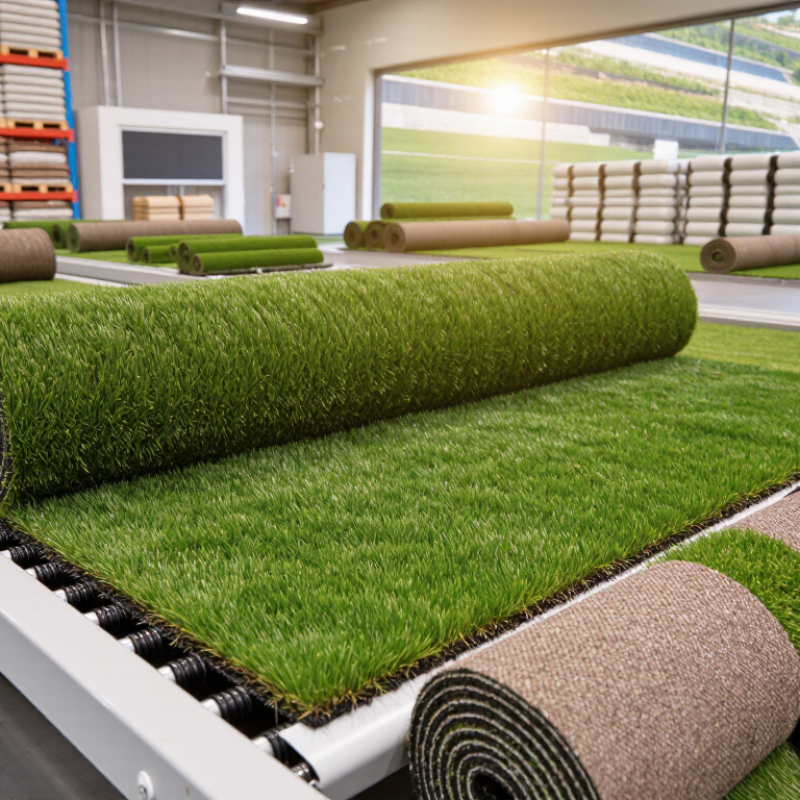
What Are China Top Synthetic Artificial Grass Suppliers?

What Is Synthetic Artificial Grass and How Is It Used?

Synthetic artificial grass is a manufactured surface designed to imitate natural turf. Most products use polyethylene or polypropylene fibers fixed into a backing layer. Small drainage holes allow rainwater to pass through. Some installations also include infill, such as sand or rubber-free mineral granules, to support the blades and improve stability.

It is used in gardens, balconies, hotel courtyards, sports areas, children’s play spaces, and indoor display zones. Landscape grass usually has a softer texture and varied green shades. Sports turf needs stronger stitching, consistent ball response, and faster drainage. Playground applications require careful attention to shock absorption and surface temperature. It is not maintenance-free. Dust, leaves, algae, and flattened fibers still need regular care.

For buyers comparing artificial grass suppliers in China, product samples reveal more than polished photographs. Check the backing strength, fiber recovery, UV resistance, drainage rate, and color consistency. Request independent test reports when safety or sports performance matters. A practical sample test can include pulling the fibers, pouring water across the surface, and inspecting the seams after repeated bending. Cheap turf may look convincing at first. It can fade, shed fibers, or develop ripples after harsh weather. I would also question vague claims about lifespan. Installation quality, sunlight, drainage, and cleaning habits affect actual performance, and supplier information alone cannot predict every site condition.

Why Choose Chinese Synthetic Grass Suppliers?

Why Choose Chinese Synthetic Grass Suppliers?

Chinese synthetic grass suppliers benefit from a dense manufacturing ecosystem. Yarn producers, backing factories, coating plants, and packaging workshops often operate within connected industrial regions. This structure can shorten development cycles and reduce coordination costs. Grand View Research valued the global artificial turf market at approximately USD 3.89 billion in 2022. It also forecast a 6.8% compound annual growth rate from 2023 to 2030. That demand encourages suppliers to improve pile height, color blending, drainage, and UV resistance.

USD 3.89 billion in 2022
6.8% compound annual growth rate from 2023 to 2030

Chinese manufacturers can support both small trials and large commercial orders. Many factories offer tufting, latex coating, and quality inspection under one roof. Buyers can request samples with different stitch rates, yarn shapes, backing weights, and infill requirements. The details matter. A football field, rooftop garden, and hotel courtyard need different specifications. Some suppliers also provide test reports for tensile strength, color fastness, water permeability, and flame behavior. These documents make technical comparisons easier, though buyers should verify laboratory scope and report dates.

Price is another practical advantage, but low cost should not decide everything. The Synthetic Turf Council reported growing attention to product durability, drainage, and responsible end-of-life planning in its industry guidance. A cheaper roll may disappoint if seams open or fibers flatten early. Not every factory is equally reliable. Independent inspections, production samples, written tolerances, and shipment checks remain necessary. Sometimes, the first sample looks better than the bulk order. That uncomfortable possibility deserves attention.

How to Identify China’s Leading Artificial Grass Manufacturers?

How to Identify China’s Leading Artificial Grass Manufacturers?

Reliable manufacturers reveal their process, not just attractive product photos. Ask for a factory address, production capacity, and recent quality records. A serious supplier should explain yarn shape, fiber density, backing layers, and drainage design clearly. Visit the facility when possible. Check whether extrusion, tufting, coating, and packing happen under controlled conditions. Look for clean work areas, labeled raw materials, and consistent inspection procedures.

Request physical samples from different production batches. Compare color, recovery after compression, stitching strength, and backing flexibility. Rub the fibers repeatedly and inspect loose strands. Place a sample under strong sunlight for several days, although this is not a complete UV test. Ask for laboratory reports covering tensile strength, color stability, flame behavior, and heavy-metal limits. Verify the testing laboratory independently. Documents alone are not enough.

Discuss your installation conditions in detail. A manufacturer serving sports fields may not suit a balcony or children’s play area. Ask how the grass performs in rain, heat, frequent foot traffic, and cold storage. Clear warranty terms matter, including exclusions and response times. Communication also shows expertise. Do they answer technical questions directly, or avoid them with sales language? No supplier gets everything right. A careful buyer should record weaknesses, not only impressive features, before choosing a long-term manufacturing partner.

What Products and Services Do Top Suppliers Provide?

Top synthetic artificial grass suppliers do more than ship rolls. They develop yarn, backing, drainage layers, and infill systems for different sites. Grand View Research estimated the global artificial turf market at about US$3.2 billion in 2022. Its report also forecasts steady growth through 2030. This trend increases demand for consistent quality, not only attractive samples.

Leading suppliers usually offer polyethylene, polypropylene, and nylon yarn options. They can adjust pile height, stitch rate, color blends, and backing strength. Products may serve gardens, sports fields, balconies, playgrounds, and pet areas. Better suppliers provide technical drawings, sample panels, installation guidance, and maintenance schedules. Some also arrange independent laboratory testing.

FIFA’s quality programme evaluates sports surfaces through ball roll, shock absorption, deformation, and rotational resistance tests. These details matter more than surface softness alone. A low-cost sample can look excellent. It may still drain poorly.

Tips: Ask for product data sheets and recent test reports. Check drainage performance after heavy rainfall. Request UV-resistance evidence for your climate. Confirm warranty terms, cleaning advice, and replacement support. I would not judge quality from color alone. That is an easy mistake. Also, compare the full installed cost, including sub-base preparation, infill, labor, and future maintenance.

How Can Buyers Compare Quality, Pricing, and Export Support?

Choosing China’s top synthetic artificial grass suppliers requires more than comparing catalogue prices. Buyers should test fibre resilience, backing stability, drainage, UV resistance, and installation consistency. FIFA’s Quality Programme requires laboratory testing for football surfaces, including ball interaction, shock absorption, and rotational resistance. These benchmarks can help buyers separate decorative turf from sports-grade products.

Pricing needs a landed-cost calculation. Request the product price, roll dimensions, loading quantity, freight estimate, import documents, and replacement policy. Grand View Research reported that the global artificial turf market was valued at approximately USD 4.79 billion in 2023, with continued growth expected through 2030. Rising demand may improve factory efficiency, but it can also hide material compromises. Ask for yarn weight, stitch rate, pile height, and backing composition. A cheaper roll may produce higher waste during cutting.

Tips: Order a physical sample first. Rub the fibres repeatedly, inspect the backing, and leave the sample under sunlight. Compare colour fading and curl recovery after several weeks. Ask for recent test reports, not generic certificates. Export support also matters. Reliable suppliers provide clear packing lists, loading photos, inspection procedures, and responsive technical communication. In my experience, delayed answers often signal weak after-sales service, although this is not always fair. Buyers should record every specification in the purchase contract and verify production before shipment.

What Are China Top Synthetic Artificial Grass Suppliers? - How Can Buyers Compare Quality, Pricing, and Export Support?

Supplier Profile Typical Product Focus Common Pile Height Primary Yarn & Construction Typical Backing Indicative FOB Price* Typical MOQ Sample & Production Lead Time Quality Verification Points Export Support Indicators
Large integrated manufacturer Landscape, sports, leisure, and custom contract projects 20–60 mm PE monofilament, fibrillated PP, or mixed yarn; 3/8–5/8 inch gauge PP primary backing with latex or PU secondary coating US$2.20–5.50/m² 500–1,000 m² per design or color Sample: 3–7 days; production: 20–35 days Third-party testing, lot traceability, tuft bind, UV resistance, drainage, and dimensional stability Container loading plans, export documentation, inspection coordination, and multi-market packaging
Mid-sized export specialist Residential landscaping, balconies, gardens, and commercial decoration 25–45 mm PE monofilament or curled yarn; usually 3/8 inch gauge PP backing with latex coating; drainage perforations commonly available US$1.80–3.80/m² 300–800 m² per specification Sample: 3–7 days; production: 15–30 days Pile weight, total weight, stitch rate, backing adhesion, color consistency, and roll length English documentation, private-label packaging, mixed-container support, and basic compliance files
Sports-surface specialist Football, multi-use fields, training grounds, and padel or recreational surfaces 30–60 mm High-tenacity PE monofilament or fibrillated yarn; 3/8–5/8 inch gauge Heavy PP backing with latex or PU coating and engineered drainage US$2.80–6.50/m², excluding infill and installation 1,000–3,000 m² per product specification Sample: 5–10 days; production: 25–45 days Wear resistance, yarn tensile strength, tuft bind, shock-pad compatibility, drainage rate, and dimensional stability Technical drawings, installation manuals, seam guidance, project quotations, and field-specific documentation
Value-focused OEM supplier Entry-level residential, event decoration, retail rolls, and temporary applications 10–35 mm PP or standard PE yarn; lower-to-medium stitch density PP backing with latex coating US$1.20–2.60/m² 200–500 m² per specification Sample: 3–5 days; production: 15–25 days Actual total weight, yarn polymer, stitch rate, backing thickness, odor, and roll measurement Flexible carton or roll labeling, small-batch customization, and standard commercial invoices
Premium design-oriented supplier Luxury landscaping, hospitality, rooftop terraces, and architectural projects 35–50 mm Multi-tone PE monofilament, textured yarn, and thatch-layer designs High-density PP backing with enhanced latex or PU coating US$3.50–7.00/m² 500–1,000 m² per design Sample: 5–10 days; production: 25–40 days Colorfastness, UV exposure results, blade recovery, appearance under different lighting, backing adhesion, and drainage Color cards, project samples, custom packaging, specification sheets, and pre-shipment inspection support
*Price note: The FOB ranges are indicative China export benchmarks for commonly traded synthetic grass products. Actual quotations vary according to yarn type, pile height, face weight, stitch rate, backing system, order volume, packaging, testing requirements, and current resin and freight costs.
Buyer comparison checklist: Request the same specification from each supplier and compare face weight, total weight, stitch rate, yarn shape, UV test method, tuft bind, drainage performance, warranty terms, production capacity, inspection procedures, Incoterms, and after-sales response time.

FAQS

How can buyers identify a reliable artificial grass manufacturer?

Ask for the factory address, production capacity, and recent quality records. Serious manufacturers explain yarn shape, fiber density, backing, and drainage clearly. Visit the facility if possible. Check clean work areas, labeled materials, and consistent inspections. Attractive photos are not enough.

What should buyers inspect during a factory visit?

Look for controlled extrusion, tufting, coating, and packing processes. Observe whether workers follow written inspection procedures. Check rolls for consistent color and stitching. Poor housekeeping may not prove poor quality, but it deserves attention.

How should buyers test physical artificial grass samples?

Request samples from different production batches. Rub the fibers repeatedly and inspect loose strands. Compress the grass, then check its recovery. Examine stitching strength and backing flexibility. Small details matter.

Can sunlight testing prove UV resistance?

No. Place a sample under strong sunlight for several days. Compare fading and fiber curling with an unexposed piece. This gives a useful warning, not a complete UV test. Laboratory evidence remains necessary.

Which laboratory reports should buyers request?

Request reports covering tensile strength, color stability, flame behavior, and heavy-metal limits. Sports surfaces may also need ball interaction, shock absorption, and rotational resistance tests. Verify the laboratory independently. Documents can still be incomplete.

Does the cheapest quotation usually offer the best value?

Not always. Calculate the landed cost, including product price, roll size, freight, import documents, and replacements. Ask about yarn weight, stitch rate, pile height, and backing composition. A cheaper roll may create more cutting waste.

How should buyers match grass with the installation location?

Discuss rain, heat, foot traffic, cold storage, and drainage needs. Sports fields require different performance than balconies or play areas. Ask how the product behaves after repeated use. The wrong specification can become an expensive lesson.

What export support should a dependable supplier provide?

Look for clear packing lists, loading photos, inspection procedures, and responsive technical communication. Confirm replacement policies and warranty exclusions in writing. Record every specification in the contract. Delayed replies can signal weak support, though this judgment is not always fair.

Conclusion

Synthetic Artificial Grass is a durable, low-maintenance surface made from engineered fibers designed to resemble natural turf. It is widely used in gardens, sports fields, playgrounds, commercial landscapes, balconies, and indoor display areas. Buyers often consider Chinese suppliers because they can offer broad product selections, flexible customization, efficient production, and competitive pricing. Many manufacturers also support international orders with packaging, documentation, sample development, and logistics coordination.

To identify leading suppliers, buyers should review manufacturing experience, material standards, production capacity, quality-control procedures, and communication efficiency. Top suppliers may provide different pile heights, fiber shapes, backing systems, colors, roll sizes, installation accessories, and tailored solutions for specific applications. When comparing options, buyers should evaluate fiber quality, density, UV resistance, drainage performance, warranty terms, total cost, and minimum order requirements rather than focusing only on the lowest price. Reliable export support, clear contracts, consistent inspection processes, and responsive after-sales service are equally important for achieving a smooth and dependable purchasing experience.

Mason

Mason

Mason is a seasoned marketing professional with a deep expertise in the company's offerings and a passion for driving brand awareness. With a strong background in digital marketing strategies, he has an innate ability to connect with diverse audiences and effectively communicate product benefits.......