Artificial Green Wall Panels are moving from decorative accents into practical tools for commercial interiors, hospitality spaces, retail displays, and compact urban projects. Grand View Research estimates that the global artificial plants market was valued at approximately USD 1.7 billion in 2023, with continued growth expected through 2030. This figure covers more than wall panels, but it signals expanding demand for low-maintenance greenery. The report also highlights commercial applications, design flexibility, and durable synthetic materials as important market drivers.
China is a major manufacturing base for this category. Its large plastics, textile, molding, and export supply chains support varied panel designs, from dense boxwood sheets to fern-rich mixed foliage. According to China’s National Bureau of Statistics, the country’s urbanization rate reached 66.16% at the end of 2023. More urban density means greater interest in vertical visual greenery, especially where irrigation, sunlight, or maintenance access is limited.
Appearance alone is not enough. A reliable manufacturer should provide UV-resistance information, fire-performance documentation, material specifications, sample approval, and consistent color batches. ISO 9001 certification can support process confidence, although certification does not automatically guarantee superior panel quality. Buyers should also examine backing strength, connection methods, odor control, packaging, and replacement availability.
No ranking is perfect. A beautiful panel may fade outdoors. A low quotation may hide weaker foliage density or limited testing. This guide evaluates ten China-based manufacturers through product range, customization ability, manufacturing experience, quality evidence, export support, and practical value. The comparison remains cautious, because real project conditions often reveal details that catalogs miss.
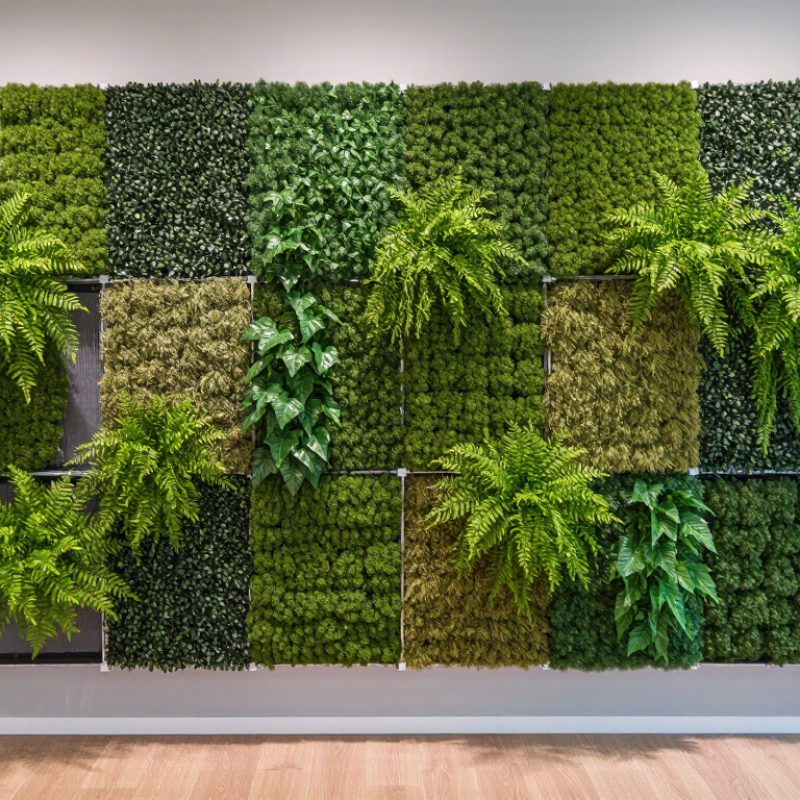
Artificial green wall panels are modular decorative surfaces that imitate living plants without soil, watering, or sunlight. They usually combine synthetic leaves, a backing layer, and a supporting frame. The word “green” can mislead. These panels are visual products, not living ecosystems.
Common types include flat foliage panels, layered jungle-style panels, grass-texture panels, and mixed-leaf designs. Flat panels suit corridors and retail walls, while deeper designs create stronger shadows and a more natural appearance. Experienced installers inspect leaf density, color variation, edge coverage, and connector strength. Repetitive patterns often reveal low-quality production. It looks natural only from a distance.
Core materials strongly affect durability. Polyethylene and polyester are often used for leaves because they are flexible and lightweight. PVC grids or mesh backings provide structure and simplify cutting during installation. Some panels include steel frames for large commercial walls. UV stabilizers can slow fading near windows, although no material stays unchanged forever. Fire-performance documentation should be requested for public interiors. Testing claims must match the actual batch, not just a product brochure.
Manufacturers should also control odor, loose fibers, uneven coloring, and weak attachment points. A careful buyer should ask for sample panels, material specifications, test reports, and installation guidance. I would not judge quality from photographs alone. Lighting can hide thin foliage and poor backing. Even experienced teams sometimes underestimate wall moisture, dust, or transport damage. These practical details influence the panel’s service life as much as its appearance.
Artificial green wall panels are modular decorative systems that combine synthetic foliage with a structural backing or core. The chart compares typical density ranges for commonly used core and backing materials. Values are representative engineering ranges in kg/m³ and can vary according to formulation, reinforcement, porosity, and manufacturing process. Polyurethane foam is lightweight and cushioning, while PVC, polyester, and polyethylene provide greater rigidity and durability.
China’s artificial green wall panel market is expanding as hotels, offices, restaurants, and retail spaces seek low-maintenance biophilic interiors. Demand is strongest where natural light is limited, irrigation is impractical, or cleaning schedules must remain predictable. Urban renovation projects are also replacing painted feature walls with textured greenery. Not every project needs a full wall. Small modular panels can reduce installation waste. Yet price remains a decisive factor.
Applications now include reception areas, apartment lobbies, shopping corridors, event backdrops, balconies, and screened outdoor zones. Experienced buyers check UV stability, flame performance, odor control, backing strength, and color consistency before comparing quotations. Panel density matters. Overly dense foliage can trap dust and make repairs difficult. Loose backing may curl after transport, especially in humid coastal regions. These details are easy to overlook. Actual performance depends on installation and maintenance.
A practical review of ten leading Chinese manufacturers should examine more than catalog variety. It should compare mold design, material traceability, sample accuracy, production capacity, packaging, and export documentation. Suppliers serve different niches, including moss panels, hedge walls, flower arrangements, acoustic greenery, and custom architectural modules. Some offer faster customization, while others provide stronger quality control for large commercial orders. Independent samples are valuable. Color can look convincing online but appear artificial under warm lighting. One weakness remains: sustainability claims are not always measured consistently. Buyers should request test records, installation guidance, and clear replacement terms.
| No. | Market Dimension | Current China Market Scope | Demand Trend | Typical Applications | Common Product Requirements |
|---|---|---|---|---|---|
| 1 | Core Product | Modular artificial green wall panels composed of synthetic foliage fixed to plastic, mesh, or composite backing. | Steady interest from projects seeking greenery without irrigation, sunlight, pruning, or regular replacement of live plants. | Interior decoration, exterior façades, retail displays, hospitality spaces, offices, and event environments. | Natural appearance, secure foliage attachment, modular installation, low maintenance, and consistent color. |
| 2 | Material Structure | Polyethylene, polypropylene, polyester, PVC, wire, and coated metal components are commonly used depending on the design and installation environment. | Buyers increasingly compare durability, UV resistance, recyclability, and odor performance rather than appearance alone. | Indoor panels, semi-outdoor landscaping, sheltered balconies, commercial walls, and temporary displays. | Material consistency, resistance to deformation, stable backing, and suitability for the intended temperature and humidity range. |
| 3 | Demand Driver | Urban commercial construction, renovation, hospitality development, and interior styling support demand for decorative vertical greenery. | Demand is shifting toward visually realistic products that reduce lifecycle maintenance costs. | Shopping centers, restaurants, hotels, coworking spaces, reception areas, and residential common areas. | Fast installation, predictable maintenance costs, design flexibility, and reliable supply for project schedules. |
| 4 | Design Segment | Popular designs include fern, boxwood, ivy, eucalyptus, grass, moss-style, tropical, and mixed-foliage panels. | Mixed textures and layered foliage are favored because they create greater visual depth than single-species designs. | Feature walls, photo backdrops, branded environments, wedding venues, and landscape-style interiors. | Color variation, realistic leaf geometry, dense coverage, easy cutting, and compatibility with custom layouts. |
| 5 | Outdoor Suitability | Outdoor use requires products specifically designed for sunlight, moisture, temperature variation, and wind exposure. | Project buyers are paying closer attention to documented UV stabilization and weathering performance. | Covered terraces, exterior entrance walls, balconies, commercial façades, and outdoor event structures. | UV-resistant polymer additives, secure anchoring, drainage awareness, wind-load planning, and suitable installation hardware. |
| 6 | Safety Considerations | Fire performance, odor, chemical emissions, and installation safety can be important for public and commercial interiors. | Commercial buyers increasingly request test reports and project-specific compliance documentation. | Hotels, offices, schools, healthcare-adjacent areas, transportation facilities, and retail premises. | Applicable fire-test documentation, low odor, stable construction, clear installation instructions, and traceable batch information. |
| 7 | Customization | Manufacturers commonly support custom panel dimensions, foliage combinations, backing systems, logos, and project-specific packing. | Custom design is especially relevant for hospitality, retail, exhibitions, and branded interior projects. | Corporate identity walls, themed venues, chain-store rollouts, showrooms, and temporary installations. | Color matching, repeatable production, sample approval, CAD-based layout support, and consistent replacement panels. |
| 8 | Procurement Model | Supply is available through direct factory orders, export traders, project contractors, wholesalers, and online B2B channels. | Large projects prioritize production capacity, lead-time control, packaging efficiency, and after-sales support. | Import distribution, landscaping projects, interior fit-outs, construction tenders, and e-commerce fulfillment. | Stable minimum order quantities, export packaging, container loading efficiency, product samples, and inspection support. |
| 9 | Regional Manufacturing Profile | Manufacturing and trading activity is concentrated in established light-industry and home-decoration supply chains, with export logistics through major coastal ports. | Buyers increasingly evaluate supply-chain resilience, quality consistency, and documentation alongside price. | Domestic construction projects and overseas distribution across hospitality, retail, residential, and event markets. | Factory audit readiness, quality-control procedures, export experience, multilingual communication, and shipment traceability. |
| 10 | Sustainability Direction | The main sustainability discussion concerns polymer selection, product lifespan, packaging reduction, repairability, and end-of-life recycling. | Longer service life and transparent material information are becoming more important in commercial procurement. | Green-building interiors, environmentally conscious retail projects, hospitality renovations, and long-term decorative installations. | Durable construction, reduced packaging, material disclosure, recyclable components where feasible, and replacement of damaged modules instead of complete walls. |
| Manufacturer Position | Anonymous Manufacturer Category | Representative Capability | Most Suitable Buyer | Information to Verify Before Purchase |
|---|---|---|---|---|
| 01 | Large-scale artificial foliage producer | Broad catalogue, repeat production, modular panel formats, and export-oriented packaging. | Importers, distributors, and multi-site commercial projects. | Production capacity, lead time, quality-control records, and product test documents. |
| 02 | Custom project panel manufacturer | Custom foliage combinations, panel layouts, color matching, and sample development. | Interior designers, contractors, and branded spaces. | Sample approval process, revision policy, minimum order quantity, and repeatability. |
| 03 | Outdoor-rated greenery specialist | UV-stabilized foliage, weather-resistant construction, and exterior installation guidance. | Façade, balcony, terrace, and outdoor event projects. | UV test method, exposure conditions, warranty terms, and fixing recommendations. |
| 04 | Interior decorative wall panel supplier | Dense foliage styles, lightweight panels, and products designed for indoor feature walls. | Offices, hotels, restaurants, retailers, and residential developers. | Odor, fire performance, backing stability, installation method, and cleaning guidance. |
| 05 | Wholesale modular panel manufacturer | Standardized panel sizes, carton packing, and regular wholesale replenishment. | Distributors, online sellers, and landscaping wholesalers. | Carton dimensions, loading efficiency, stock availability, and replacement policy. |
| 06 | Event and display greenery producer | Lightweight decorative panels, quick assembly, and short-term display solutions. | Exhibition contractors, event agencies, and photo-studio operators. | Weight, reusable construction, packing protection, and installation time. |
| 07 | Mixed-material artificial landscape manufacturer | Combination of foliage, moss-style textures, flowers, grasses, and decorative accessories. | Hospitality, themed interiors, and landscape design studios. | Material composition, color consistency, component attachment, and cleaning requirements. |
| 08 | OEM and private-label producer | Private packaging, custom labels, product revisions, and buyer-specific specifications. | Overseas brands, importers, and retail chains. | Tooling ownership, confidentiality, packaging approval, inspection rights, and production records. |
| 09 | Small-batch design-led manufacturer | Flexible design development, lower-volume customization, and sample-oriented production. | Boutique hotels, design firms, restaurants, and specialty retailers. | Minimum order quantity, production scalability, design ownership, and color tolerance. |
| 10 | Project-integrated greenery supplier | Product supply combined with layout advice, quantity planning, installation support, and replacement service. | Construction contractors, architects, developers, and facility managers. | Site measurements, fixing system, installation responsibility, maintenance guidance, and service response. |
Note: Company names, brand names, rankings, revenue figures, and brand-level performance data are intentionally omitted. The manufacturer section uses anonymous, non-brand categories to summarize the principal supplier types active in the China artificial green wall panel market.
When evaluating the top 10 China artificial green wall panel manufacturers, UV resistance deserves close attention. Outdoor panels may face strong sunlight, heat, rain, and seasonal changes. Ask for accelerated UV test reports, color-retention data, and installation guidance. A sample should also be inspected after exposure. Slight fading can appear earlier than expected.
Fire rating is equally important, especially in hotels, offices, restaurants, and public interiors. Reliable manufacturers should provide traceable test certificates from recognized laboratories. Check the tested product, not just the raw material. Backing layers, adhesives, and decorative leaves can change the final result. Fire performance must match the intended building location and local requirements.
Durability includes more than a strong-looking surface. Pull the foliage gently, examine the mesh, and check how panels connect at the edges. Good products resist shedding, deformation, moisture, and repeated handling. Ask about impact testing, temperature limits, cleaning methods, and replacement parts. Manufacturer experience matters here; clear technical answers often reveal better process control.
A practical evaluation should score evidence, not attractive photographs. We might rate UV resistance, fire rating, durability, material consistency, and after-sales support. The scoring will never be perfect. Installation quality can still affect performance significantly. Even a well-tested panel may fail when exposed to unsuitable heat, poor drainage, or careless cutting. Small details matter.
China’s top artificial green wall panel manufacturers serve commercial, hospitality, residential, and outdoor projects. Their product ranges usually include UV-resistant PE or PVC foliage, modular panels, preserved-style designs, and custom landscape sections. Strong suppliers provide factory samples, installation drawings, color options, and replacement panels. Production capacity varies widely, so buyers should confirm monthly output, minimum order quantities, and realistic lead times.
Reliable manufacturers usually maintain ISO 9001 quality systems and may offer CE, RoHS, REACH, or fire-performance documentation. Certification must match the actual product, not merely the factory profile. Export experience commonly covers North America, Europe, Australia, the Middle East, and Southeast Asia. A professional supplier should explain packaging methods, container loading, inspection procedures, and after-sales support. Factory audits and independent laboratory reports add useful evidence. Still, even a polished catalog can hide uneven foliage density or weak backing materials. Physical samples remain essential.
Tips: Request three samples. Check color consistency, backing strength, odor, UV claims, and fire-test scope. Ask for production photographs and recent export references. Compare usable coverage, not only panel size. A lower price can reflect thinner leaves, poorer connectors, or higher installation waste. Some manufacturers respond quickly but provide vague technical answers; treat that as a warning. A dependable partner communicates limitations clearly and records agreed specifications before production.
When comparing the top 10 China artificial green wall panel manufacturers, request complete fire-test documents, not marketing claims. EN 13501-1 classifies reaction to fire using European criteria, including flame spread, heat release, and smoke production. ASTM E84 measures flame spread and smoke-developed indexes under a different test method. These ratings are not interchangeable.
Look for the exact panel construction tested. A PVC backing, adhesive layer, or dense foliage can change performance. Ask whether the report covers the finished assembly, not only a raw sample. The test number matters. So does the laboratory’s accreditation. Density should be recorded in kilograms per cubic meter, but higher density does not automatically mean better fire resistance. It may improve rigidity while increasing shipping weight and installation load.
Warranty terms reveal manufacturing discipline. Check coverage for color fading, UV damage, shedding, backing separation, and dimensional change. Five years sounds useful, but exclusions may remove outdoor exposure or improper cleaning. Ask for installation limits, maintenance duties, and replacement procedures in writing. Small details matter. I have seen attractive samples fail practical review because the backing warped near a warm window. A supplier with traceable batch records, clear technical sheets, and responsive after-sales support deserves more confidence. Still, one comparison table cannot replace an independent site assessment.
Request accelerated UV test reports and color-retention data. Inspect a sample after strong light exposure. Slight fading may appear earlier than expected.
It should identify the tested panel, not only the raw material. Check the foliage, backing, mesh, and adhesives. Match the result with local building requirements.
Pull the foliage gently. Inspect the mesh, edges, connectors, and backing. Check for shedding, bending, moisture damage, and loose leaves.
Ask for samples, installation drawings, color options, and replacement panels. Confirm monthly output, minimum order quantities, and realistic lead times. Details matter.
Quality-system records, laboratory reports, and product-specific fire documents can help. Certificates should match the actual panel. A factory profile alone proves little.
Photos may hide uneven foliage or weak backing. Compare leaf density, color consistency, odor, connector strength, and usable coverage. Samples reveal more.
Ask about carton protection, container loading, inspection steps, and delivery timing. Request recent project references when possible. Packaging can affect panel condition.
Compare usable coverage, material thickness, connector quality, and installation waste. A lower price may mean thinner leaves or weaker backing. The cheapest option is not always efficient.
Yes. Poor drainage, unsuitable heat, careless cutting, and weak fixing can reduce performance. Testing helps, but installation still matters. Our scoring will never be perfect.
This article provides a practical overview of Artificial Green Wall Panels, explaining their definition, common types, structural designs, and core materials such as synthetic foliage, backing boards, steel frames, and protective coatings. It also examines China’s expanding market, including demand trends and applications in commercial interiors, hospitality, public spaces, residential projects, and outdoor landscaping. A carefully selected group of ten leading manufacturers is introduced without focusing on brand promotion, highlighting their product ranges, production capabilities, certifications, and export experience.
To support informed purchasing decisions, the article evaluates manufacturers through five key criteria: UV resistance, fire performance, weather durability, material quality, and long-term maintenance requirements. It further compares relevant technical indicators, including EN 13501-1 and ASTM E84 fire classifications, panel density, structural stability, and warranty terms. The goal is to help buyers assess product safety, service life, customization options, and overall suitability for different project environments.

Deyuan Industry